
Writing WBSO applications in Twin
Twin writes WBSO applications for application year 2027 the way RVO wants to receive them: one document per project form, filled from your sources, exported as the PDF that the RVO portal imports. This article is the map. Three companion articles walk through the situations you meet every season: a follow-up on last year's project, a client with several developments, and RVO's questions letter.
One document, one RVO project form
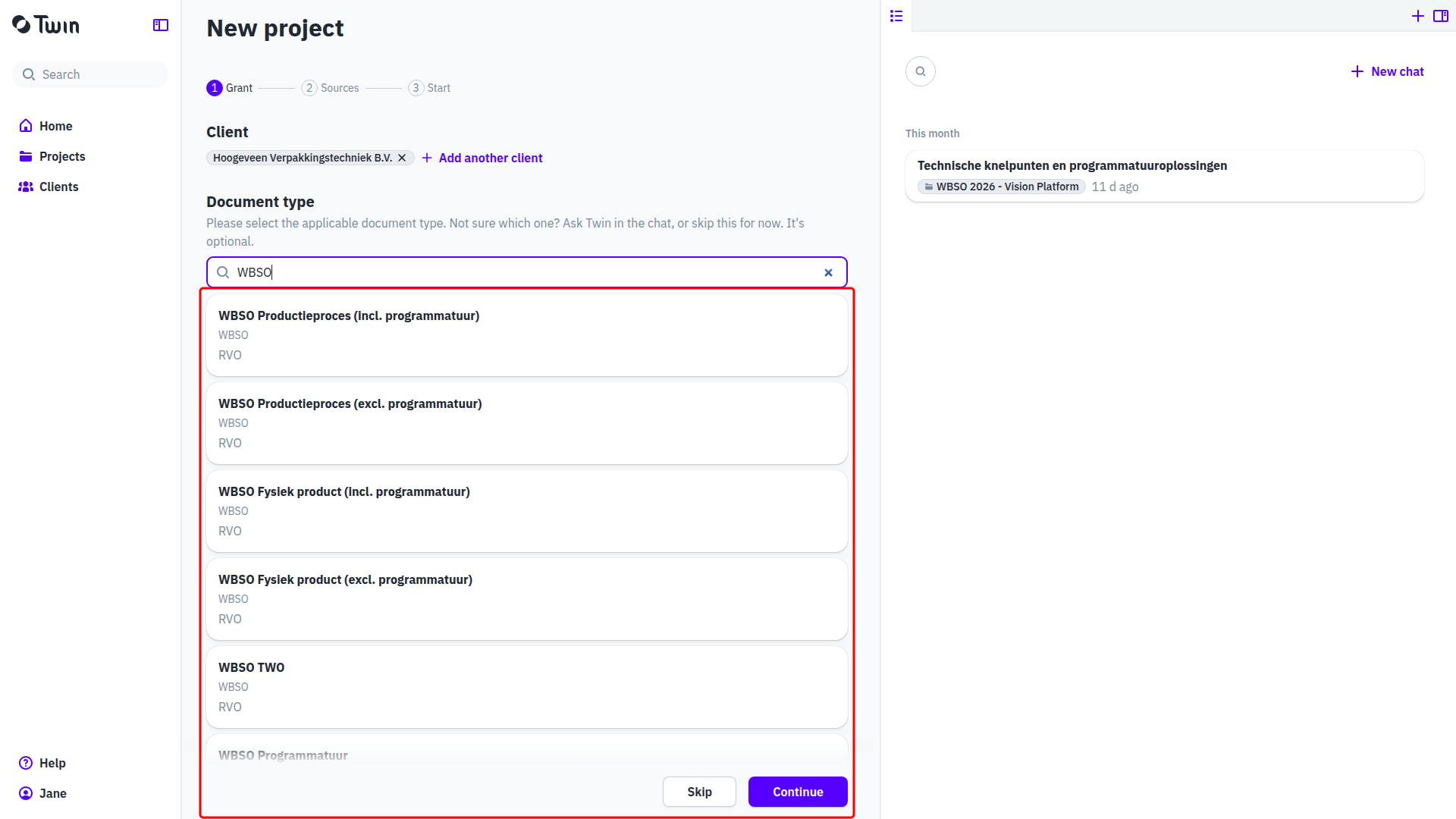
A WBSO application consists of one or more projects, and RVO asks for a separate project form per project. In Twin that is one document per project, all inside one project for the client. Pick the document type that matches RVO's form:
| Document type in Twin | RVO project form | Use it for |
|---|---|---|
| WBSO Programmatuur | Ontwikkelingsproject programmatuur | Software: a new algorithm, engine, platform or embedded software. |
| WBSO Fysiek product (excl. programmatuur) | Ontwikkelingsproject fysiek product of productieproces | A physical product without software of its own. |
| WBSO Fysiek product (incl. programmatuur) | Same form, with the software sections added | A physical product that also contains technically new software. |
| WBSO Productieproces (excl. programmatuur) | Ontwikkelingsproject fysiek product of productieproces | A new or improved production process without software of its own. |
| WBSO Productieproces (incl. programmatuur) | Same form, with the software sections added | A production process whose control or measurement software is part of the development. |
| WBSO TWO | Technisch-wetenschappelijk onderzoek | Explanatory research into a technical phenomenon, with research questions instead of bottlenecks. |
The six types are shared with every Twin organisation. If you do not see them in the New document dialog, let us know.
What the assistant does with your sources
Upload what the client gave you: the intake notes, last year's application, the granted decision, a status update. Twin reads them and proposes a project plan with the technical bottlenecks numbered TK1, TK2, ... and the solution directions numbered OR1, OR2, ..., so that every solution answers one bottleneck. You approve the plan before a single section is written. Each section then follows the RVO instruction for that field: what belongs in it, in what order, and how long it may be.
Twin's WBSO knowledge base is updated for 2027. Ask the assistant anything about the scheme and it answers from the RVO manual, the three project forms and the Prinsjesdag documents, with the source named. The parameters it knows: rates unchanged at 36%, 50% for starters and 16% above the first bracket; the flat-rate S&O hourly wage moving from 29 to 33 euros (proposed in the Fiscale verzamelwet 2027, still before the Tweede Kamer, committee debate on 29 September 2026); the pharmacy letter (farmaciebrief) ending on 1 January 2027; and the deadline of 20 December 2026 for an application period that starts on 1 January. The Prinsjesdag letter of 15 September 2026 confirms that 2027 is a stable year: the WBSO budget is 1,968 million euros, and the changes the minister announced for costs, prototypes and software land in 2028 or 2029.
What the download contains
Click Download in the document header and choose Latest version. Twin produces two files:
- The filled RVO project form (PDF), RVO's own form (version 1.81 today; RVO has announced more room in the form for 2027, and Twin follows the current version). Every field is filled from the matching section: KvK number, project number, description, start date, the milestone table, the partner table, the numbered bottlenecks and solutions, hours, and the four cost fields. This is the file you import in the RVO portal.
- The same text as a Word file, for reviewing with the client or keeping in your own dossier.

The field limits come from RVO's form itself and Twin keeps the text inside them: 1,500 characters for the long text fields (description, bottlenecks, solutions, novelty, update), 500 characters per cost field, 200 for the project name, 120 per milestone line, at most 10 milestones and 5 partners. Should a section still run longer, the PDF field is cut at the limit while your document and the Word file keep the complete text.

The three situations, step by step
- Continuing last year's WBSO project: the follow-up application, from last year's PDF or from last year's Twin document. The original start date stays, solved bottlenecks move to the update, the milestones get 2027 dates.
- One client, several developments: the assistant sorts the portfolio into S&O projects and non-S&O work, you confirm, and Twin writes one document per RVO form.
- Answering RVO's questions letter: paste the letter, get a note with the literal questions and the answers, export it to Word.
What you still do in the RVO portal
Twin delivers the project forms. The application itself is submitted by you or the client in the RVO portal (eLoket). Keep this list at hand:
- Import the PDF project form per project, and check the fields that the portal shows.
- Enter the S&O hours per project and check the total for the application period.
- Choose the cost option for the whole application: flat rate (forfait) or actual costs and expenses. Twin fills the four cost fields only when the sources contain a budget for actual costs; under the flat rate the descriptions read "Niet van toepassing" and the amount fields stay empty, as RVO's form asks.
- Add the S&O employees for the applicant, and the authorisation (machtiging) when you submit as an intermediary.
- Submit before the deadline. For a period starting 1 January 2027 that is 20 December 2026, a Sunday; RVO's helpdesk is closed at the weekend, so submit on Friday 18 December.
Good to know
- An application period starts on the first day of the month after submission and always runs to 31 December, so the hours in the document cover the period up to 31 December.
- A document you started on an earlier version of a WBSO document type keeps that version. Start a new document to write against the 2027 instructions.
- The assistant does not invent facts. When a source does not answer a question, it says so and asks you; that is deliberate, not a gap.
See also Starting a document, Sources: what Twin writes from and Exporting your document.